
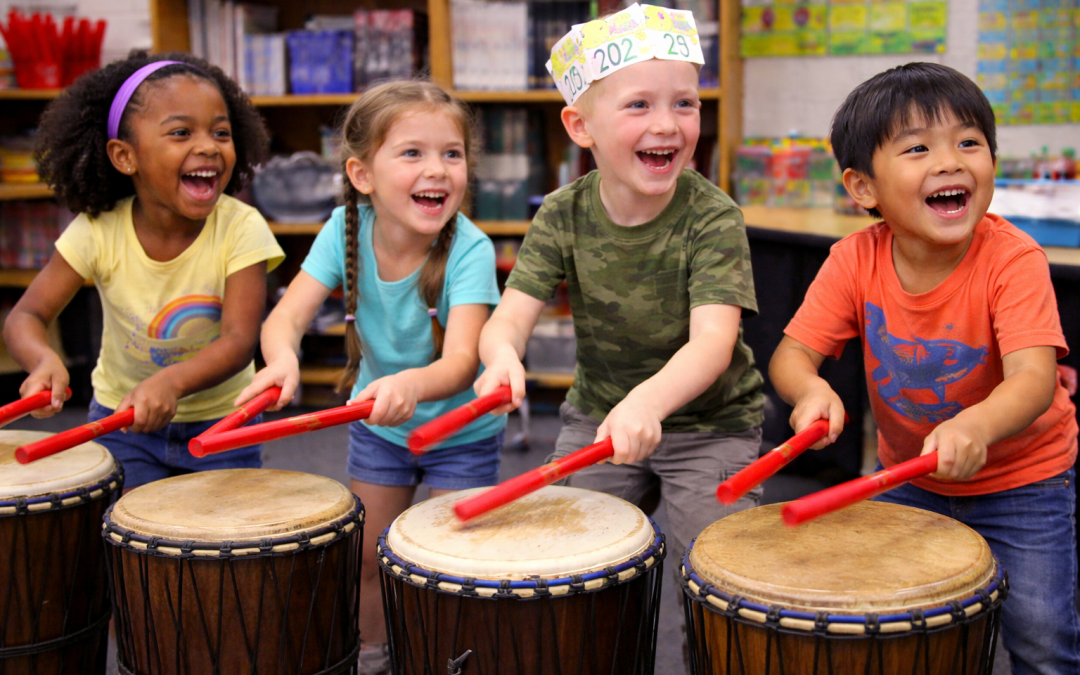
More schools are bringing drumming into the school day because it’s a simple, low-barrier way to build focus, confidence, coordination, and community without requiring students to have prior music training.
1) Drumming meets kids where they are
Not every student connects with traditional band or choir right away. Drumming is different: you can participate on day one.
- No need to read music to start
- Success happens fast (which boosts confidence)
- It works for a wide range of ages and ability levels
2) It supports attention, self-regulation, and classroom readiness
Rhythm is structure. When students practice steady beats, starts/stops, and call-and-response patterns, they’re also practicing skills that show up in the classroom.
- Listening for cues
- Controlling impulses (wait, then play)
- Staying with a group
- Resetting after a mistake
Teachers often notice that a short rhythm activity can help students “come back to center” before transitions.
3) It builds coordination and brain-body connection
Drumming naturally blends movement and timing. Even simple patterns ask students to coordinate hands, sometimes feet, and often voice.
- Cross-body coordination
- Fine and gross motor skills
- Timing and sequencing
For many kids, this kind of learning clicks faster than purely verbal instruction.
4) It creates belonging fast
One of the best things about a drum circle is how quickly it turns a room into a team.
- Everyone contributes to the same groove
- Students feel seen and heard
- The group experience reduces pressure on individual performance
That sense of belonging matters especially for students who don’t always feel like they “fit” in other activities.
5) It’s inclusive by design
Drumming can be adapted in real time. Students can participate with:
- One hand
- A shaker instead of a drum
- A simplified rhythm
- A partner or small-group role
This flexibility is a big reason schools exploring sensory-friendly and neurodiversity-affirming activities are leaning into percussion.
6) It strengthens social-emotional learning (SEL)
Drumming is emotional, expressive, and relational. In a well-run session, students practice:
- Taking turns and sharing leadership
- Encouraging peers
- Managing volume and intensity
- Expressing feelings through rhythm
It’s SEL without a lecture.
7) It connects to culture and community
Percussion exists in every culture. Schools can use drumming to support:
- Cultural celebrations and heritage months
- Cross-curricular lessons (history, geography, language arts)
- Community-building assemblies
When done respectfully, it’s a powerful way to broaden students’ understanding of music beyond one tradition.
8) It’s practical for schools
Compared to many music programs, drumming can be surprisingly easy to implement.
- Instruments are durable
- Group participation is built in
- Sessions can work in a gym, cafeteria, or classroom
- Schools can start with a one-time workshop and scale up
A strong session isn’t just “make noise.” It’s structured, energetic, and student-centered.
- Quick warm-up (clapping/body percussion)
- Simple groove everyone can do
- Call-and-response for listening and focus
- Layering parts (teamwork)
- A short “student-led” moment
- Cool-down and reflection
Bring drumming to your school
If you’re exploring drumming for assemblies, classroom enrichment, or a wellness-focused program, I offer interactive drumming workshops designed for real classrooms—high participation, clear structure, and lots of fun.
Learn more here: Workshops