
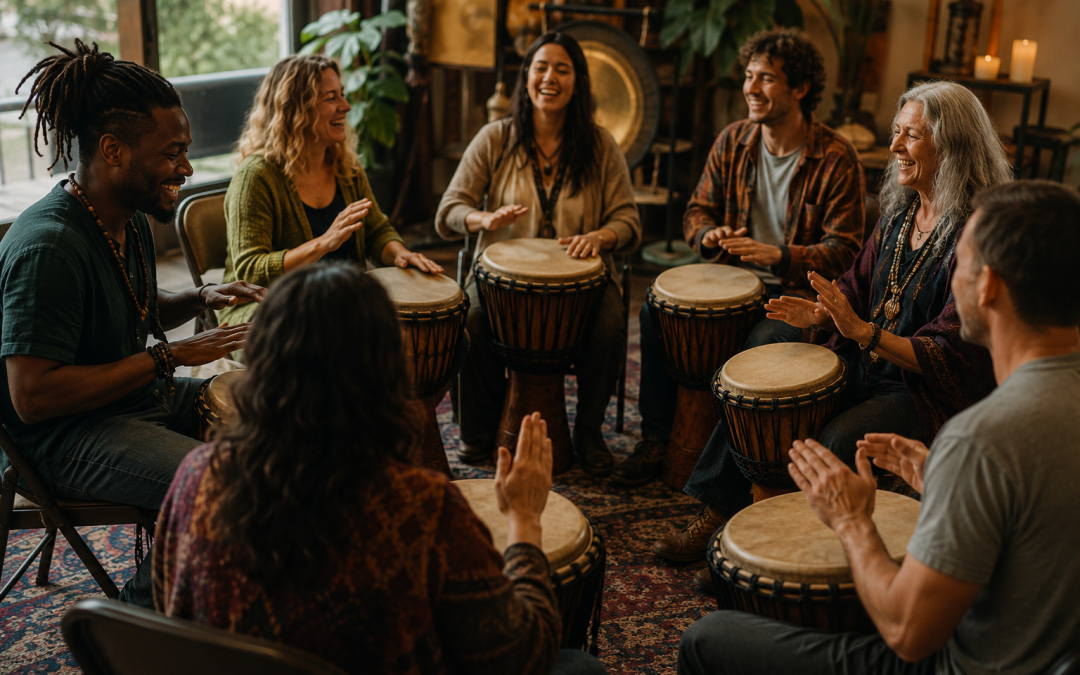
There’s a moment that happens in almost every drum circle, usually about five minutes in. People stop thinking about whether they’re doing it right. They stop watching their hands. They stop worrying about keeping up with everyone else. That’s when it becomes clear — what’s happening in this room is more than music. It always has been.
And then something shifts.
The rhythms lock in. The room fills with sound. And without anyone planning it, a group of individual people becomes something more, something that moves and breathes together.
That moment isn’t an accident. It’s science. It’s psychology. And it’s one of the most quietly powerful things a human being can experience.
At Dan’s Drumming in Lodi, Wisconsin, we see it happen every week. So let’s talk about what’s actually going on when a group starts drumming together.
The Brain on Rhythm: Proof That Drumming Is More Than Music
When you play music alone, your brain is already working hard coordinating motor skills, timing, listening, and creativity all at once. But when you play music with others, something extraordinary is added to the mix. Research has shown that when people engage in rhythmic activities together, their brainwaves begin to synchronize a phenomenon sometimes called neural entrainment. In simple terms, the brains of people playing music together start to “lock in” with one another, almost like they’re on the same frequency. This synchronization isn’t just interesting from a neuroscience perspective it has real, felt effects. People in synchronized rhythm together report feeling more connected, more cooperative, and more empathetic toward one another. In one notable study, children who performed synchronized movements together were more likely to help each other afterward, even with no other connection between them. The drum doesn’t just make music. It builds bridges between minds.The Body Gets In On It Too
You don’t have to play drums for very long before you notice a physical change. Your breathing deepens. Your shoulders drop. The thing you were stressed about an hour ago starts to feel a little further away.
That’s not just your imagination, it’s your nervous system responding.
Group drumming has been studied for its effects on cortisol levels (the body’s primary stress hormone), and the results are consistently compelling. Studies, including one conducted at the Neurologic Music Therapy Services of Arizona, found that group drumming reduced cortisol and increased natural killer cell activity, meaning the immune system got a measurable boost.
Meanwhile, drumming stimulates the release of endorphins, the same chemicals triggered by exercise and laughter. When those endorphins flood your system alongside the social warmth of making music with others, the result is a feeling that’s hard to put into words but very easy to recognize.
People leave drum circles happier. Not as a matter of opinion. As a matter of biology.
What Happens to a Group Not Just an Individual
Here’s where it gets really interesting.
Individual wellness is wonderful. But group drumming does something that most solo wellness practices simply can’t: it creates collective cohesion in real time.
When people drum together, they enter a shared experience that requires listening, adjusting, supporting, and leading sometimes all within the same measure. You can’t drum in a group while only thinking about yourself. The music demands that you pay attention to everyone else in the room.
Over time, this creates something researchers call a “we” experience a felt sense of belonging to something larger than yourself. In communities and organizations that have used drum circles intentionally (from corporate team-building events to addiction recovery programs to school classrooms), the effects on group cohesion have been consistent and significant.
People who drum together tend to:
- Trust each other more shared vulnerability creates connection
- Communicate more openly the drum circle is a judgment-free zone
- Support each other better rhythmic synchrony literally primes cooperative behavior
- Feel less isolated even one session can reduce feelings of loneliness
In a world where loneliness is increasingly described as a public health crisis, this matters more than ever.
You Don’t Need to Be a Musician
One of the greatest myths about drumming, especially group drumming, is that you have to be musical to participate. Or that you need to keep perfect time. Or that you have to know what you’re doing before you show up.
You don’t.
The drum circle is uniquely democratic. No prior experience required. No audition. No expectation that you’ll play anything “correctly.” A beginner playing a simple, steady beat contributes something real and important to the collective sound. And more often than not, experienced drummers will tell you that the most joyful sessions they’ve ever had involved complete beginners finding their groove for the first time.
There’s also something powerfully equalizing about the drum circle. In everyday life, we bring our titles, our anxieties, our social roles. Around the drums, most of that falls away. What you bring is your rhythm and your willingness to be present.
Community Drumming in Lodi, WI
Here at Dan’s Drumming, our mission has always been bigger than teaching people how to play. It’s about what happens when people make music together: the trust, the joy, the sense of shared humanity that emerges when a group locks into a groove.
Whether you’re a total beginner curious about what a drum circle feels like, an experienced player looking to connect with others, or a community leader exploring how drumming might serve your group or organization, we’d love to have you in the circle.
Because once you’ve felt that shift, that moment when the room breathes together and everything clicks, it’s impossible not to want more of it.
Ready to Experience It for Yourself?
Join us at Dan’s Drumming in Lodi, Wisconsin. Whether it’s a community drum circle, a private session, or a group event, we’ll bring the drums, the guidance, and the groove.
Lodi, Wisconsin