
As a parent of a child with autism, you’ve probably learned to be a skilled researcher. You know how to sift through what sounds promising and what actually delivers. So when you search “drum lessons in Madison, WI” and wonder whether music could be good for your child you deserve a real, honest answer.
Here it is: traditional drum lessons may not be the best fit. But an interactive rhythm program? That’s a different story entirely.
Why Parents of Kids with Autism Search for Music Programs
Music has a well-documented relationship with the brain and that relationship is especially powerful for individuals on the autism spectrum.
Parents search for drum lessons for all kinds of reasons:
- Their child is drawn to rhythm and responds to it in ways they don’t respond to much else
- A therapist, teacher, or specialist suggested music as a beneficial outlet
- They’re looking for a safe, joyful activity that builds confidence and social skills
- They want their child to feel a sense of achievement and belonging
All of these are exactly right. The instinct to explore rhythm and drumming for a child with autism is a good one. The key is finding the right kind of program.
The Limitations of Traditional Drum Lessons for Kids with Autism
Standard drum lessons are built around a one-size-fits-all structure: sit down, follow instructions, practice a pattern, get corrected, try again. For neurotypical students motivated by achievement and skill-building, this works well.
For many children with autism, however, this structure creates friction at almost every step.
Sensory Overwhelm
A drum kit in a small studio can be extraordinarily loud. Without the right setup and pacing, what should be an exciting experience can quickly become distressing for a child with auditory sensitivities.
Rigid Expectations
Traditional lessons have a clear goal: learn to play drums correctly. For a child whose brain processes instruction, repetition, and correction differently, this can lead to shutdown, frustration, or refusal.
One-on-One Pressure
Being the sole focus of an instructor’s attention with nowhere to look, nowhere to move, no flexibility in the structure can feel overwhelming rather than supportive.
Lack of Meaningful Connection
Children with autism often thrive with connection built through shared experience rather than face-to-face instruction. A traditional lesson format doesn’t always create that.
None of this means your child can’t or shouldn’t drum. It means the delivery method matters enormously.
What Makes Interactive Rhythm Programs Different
An interactive rhythm program isn’t about teaching your child to play drums. It’s about meeting your child in the rhythm and letting the rhythm do the work.
Here’s what sets this approach apart:
1. Participation Over Performance
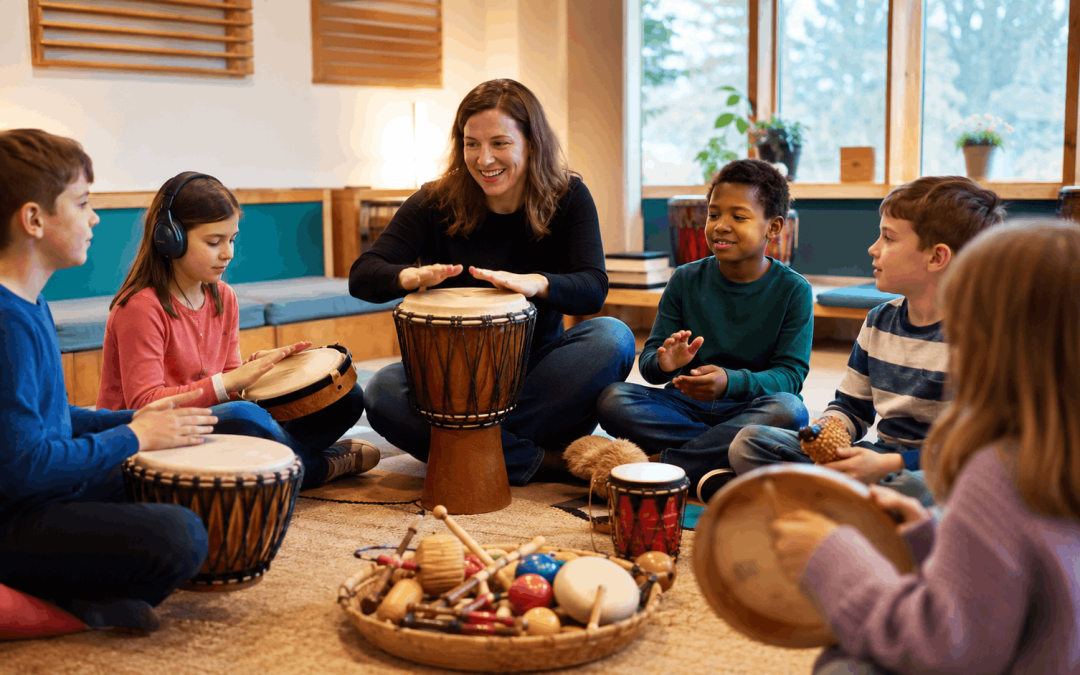
In an interactive rhythm session, every child contributes. There’s no right way and no wrong way. The sound of the group is the goal and every beat your child plays is part of that. This removes the pressure to perform and replaces it with the freedom to just be.
2. Sensory-Friendly by Design
Good interactive rhythm programs are thoughtfully designed around sensory needs. Instrument choices, volume levels, pacing, and physical space are all considered. Children are given options, not mandates.
3. Rhythm as Predictable Structure
For many children with autism, the world feels unpredictable and hard to navigate. Rhythm is the opposite it’s a reliable, repeating pulse. The beat keeps coming back. That predictability is deeply regulating for many kids, reducing anxiety and increasing their capacity to engage.
4. Social Connection Without Social Demands
One of the most remarkable things about drumming in a group is that it creates connection without requiring direct social interaction. A child doesn’t have to make eye contact, initiate conversation, or navigate complex social rules. They just play and in playing together, something real and meaningful happens between people.
5. Movement-Friendly and Body-Positive
Interactive rhythm isn’t about sitting still. It’s physical, energetic, and expressive. For children with autism who need to move, fidget, or process through their bodies, drumming gives that energy somewhere to go.
Real Results Families See
Families who bring their children with autism to interactive rhythm programs often describe results they didn’t anticipate:
Increased focus and regulation
kids who struggle to stay engaged for more than a few minutes will drum for 30, 45, even 60 minutes
Spontaneous vocalization and communication
Children who are minimally verbal sometimes begin to hum, count, or call out during rhythm activities
Reduced anxiety in new settings
The structure of the rhythm creates a safe container, making new environments less threatening
Confidence and pride
When a child realizes they can contribute to something that sounds good, the look on their face says everything
Family connection
Parents and siblings who drum together with their child often describe it as one of the most connected experiences they’ve shared
How Dan’s Drumming Serves Families Near Madison, WI
Dan’s Drumming was built for exactly this community. Based in Lodi, Wisconsin just 30 minutes from Madison Dan brings fully customized, interactive group drumming experiences to families, autism programs, schools, and care organizations throughout southern Wisconsin.
Every session is adapted in real time to the individuals in the room. If a child needs more space, a different instrument, a gentler volume, or a slower pace that happens. If a child lights up and wants to lead the group that happens too. The session follows the children, not the other way around.
There’s no curriculum to follow. No wrong notes. No pressure. Just rhythm, joy, and the kind of breakthrough moments that parents remember for years.
Dan’s Drumming works with:
- Autism support organizations and therapy programs
- Families seeking private group sessions for their child
- Special education classrooms and inclusion programs
- Milestone celebrations and family events
You Don’t Have to Keep Searching
If you’ve been looking for drum lessons in Madison, WI for your child with autism and something just hasn’t felt quite right it’s because what your child needs isn’t a lesson. It’s an experience.
Dan’s Drumming delivers that experience. And we’d love to bring it to your family.
- Serving Lodi, Madison & all of southern Wisconsin
- Reach out today to schedule a session or ask any questions. We’re here for families just like yours.
Every child has a rhythm inside them. Dan’s Drumming helps them find it.