
The simple activity that changes the whole room
If you’ve ever walked into a senior living community during a typical afternoon, you’ve probably seen the same challenge: people are present, but not always engaged. Energy can be low. Conversation can be quiet. And it can be hard to find activities that truly reach everyone, especially residents living with memory loss.
That’s where interactive drumming for seniors comes in.
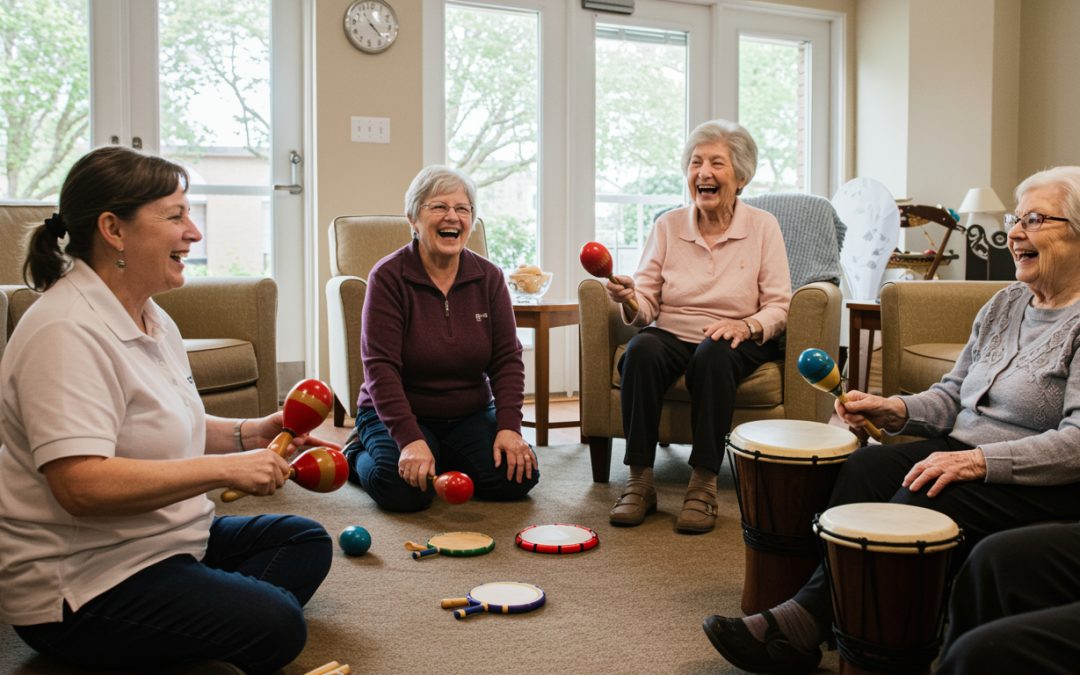
I’ve seen it again and again: put a drum in someone’s hands, give them a rhythm they can follow, and something shifts. Faces brighten. People sit up taller. Hands start moving. And for an hour, the room feels connected.
Interactive drumming for seniors isn’t just entertainment. It’s a powerful way to support quality of life emotionally, socially, physically, and cognitively.
Why Music Reaches Where Words Can’t
When you understand how the brain works and how memory loss affects it you start to see why music therapy is so powerful for memory care.
The prefrontal cortex, responsible for verbal memory and recent events, deteriorates with dementia. But the areas of the brain that process music, rhythm, and emotion remain relatively intact, even in advanced stages. This is why residents who can’t have a conversation can still sing, move to a beat, and respond emotionally to melody.
Music also triggers the release of dopamine the neurochemical associated with pleasure, motivation, and reward. In memory care settings, this matters. A lot.
When residents engage with music, their brains light up. They feel something. They connect. And that connection even if it’s just for an hour changes the quality of their day.
1) It creates a real connection (even for quiet or non-verbal residents)
One of the best parts about drumming is that you don’t need to “be good at music” to participate. You don’t need perfect words. You don’t even need a strong memory.
Rhythm meets people where they are.
In group drumming sessions, residents are doing something together at the same time listening, responding, and contributing. That shared experience builds connection quickly, even between residents who don’t usually interact.
2) It boosts mood and reduces stress
Music has a direct line to emotion. Add movement and participation, and it gets even more powerful.
Drumming gives seniors a safe, upbeat way to release tension and express themselves. It’s active, but not overwhelming. Structured, but still playful. And because it’s interactive, residents aren’t just watching they’re doing.
Many staff members tell me they notice residents are in better spirits after a session. Sometimes the positive mood lasts well beyond the hour.
Why it works:
- Repetition is calming
- Group rhythm creates a sense of safety and predictability
- Music encourages laughter, joy, and emotional release
3) It supports memory and cognitive engagement
Interactive drumming naturally exercises the brain.
Following a beat, copying a pattern, switching rhythms, and responding to cues all require attention and processing. And when you pair drumming with familiar sing-alongs, you’re also tapping into long-term memory often the strongest type of memory for seniors, even with dementia.
Cognitive benefits you may notice:
- Increased focus during the activity
- Better responsiveness to prompts and cues
- Moments of recognition during familiar songs
- Improved alertness and engagement
Even small wins matter. A resident who is “checked out” most of the day but locks in during music is experiencing a real improvement in quality of life.
4) It encourages movement in a gentle, accessible way
You don’t need a full workout to support physical well-being. For many seniors, especially those with mobility limitations, small movements are meaningful.
Drumming naturally encourages:
- Hand and arm movement
- Cross-body coordination
- Clapping and tapping
- Posture changes (sitting up, leaning in, turning toward others)
And because it’s fun, residents often move more than they would during a typical exercise program.
5) It builds confidence and gives seniors a sense of purpose
A lot of senior activities are passive: watching a performance, listening to a speaker, sitting through a program.
Interactive drumming flips that.
Residents become participants. Contributors. Leaders. They get to create something that matters in the moment. That feeling—I can still do this—is huge.
You’ll often see residents light up when they realize they can follow the rhythm, keep the beat, or help the group stay together. That confidence carries into how they feel about themselves.
Why senior living communities love interactive drumming sessions
From an activity coordinator’s perspective, interactive drumming checks a lot of boxes:
- Works for a wide range of cognitive and physical abilities
- Keeps attention better than many seated programs
- Creates visible engagement (great for families and staff morale)
- Encourages participation without pressure
It’s one of those rare activities where you can look around the room and see the impact immediately.
Want to bring interactive drumming to your community?
If you’re looking for an activity that boosts engagement, lifts mood, and helps residents feel connected, interactive drumming is a great fit.
If you’d like, I can help you choose the best session style for your group size and resident needs whether you’re in assisted living, independent living, or memory care.